LGBTQ divorces in Texas add layers around parentage, community-property timelines, and alimony (often tied to legal marriage length). The smartest move is working with an LGBTQ-informed family-law attorney and considering mediation for privacy and control.
- Parentage: secure the nonbiological parent’s rights (e.g., second-parent/stepparent adoption).
- Property: Texas divides community assets from the legal marriage period; tracing/commingling matters.
- Alimony: courts usually look to the legal marriage length, not the whole relationship.
- Mediation: cost-effective, confidential, and can credit the full relationship history.
- Litigation: choose counsel fluent in LGBTQ issues, Texas procedure, and evidence/tracing.
LGBTQ divorce lawyers play a crucial role in ensuring that LGBTQ couples receive fair treatment during a divorce. If you need quick advice, here are the key points:
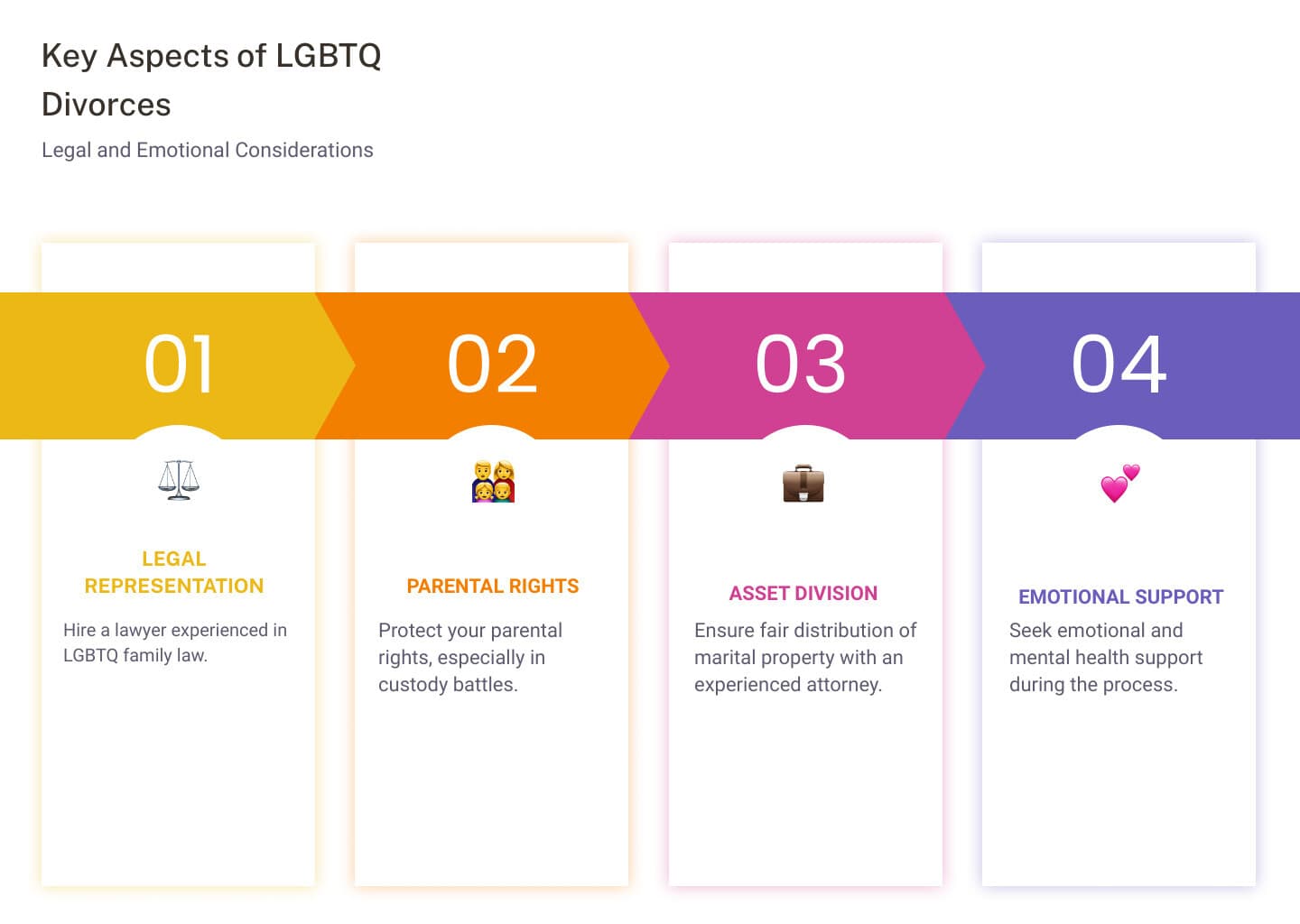
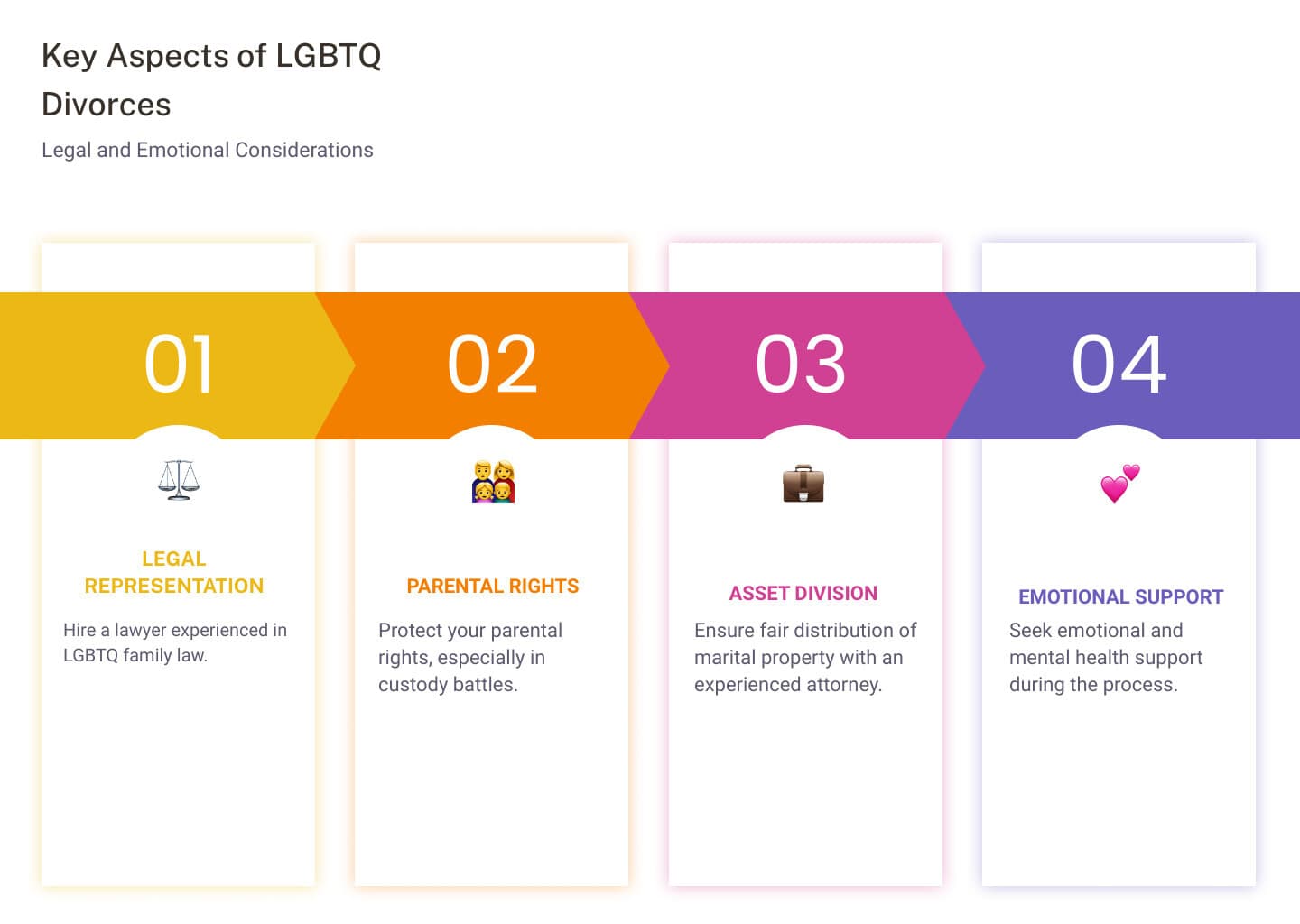
- Legal Representation: Hire a lawyer experienced in LGBTQ family law.
- Parental Rights: Protect your parental rights, especially in custody battles.
- Asset Division: Ensure fair distribution of marital property with an experienced attorney.
- Emotional Support: Seek emotional and mental health support during the process.
While every divorce is challenging, LGBTQ divorces come with unique problems. Even in a progressive state like Texas, navigating the legal landscape can be tricky. From parental rights to property division, LGBTQ couples must consider multiple complexities. These legal intricacies demand the expertise of a seasoned LGBTQ divorce lawyer who understands these specific issues.
Divorce is tough for everyone, but LGBTQ couples face some unique challenges. Let’s break down the key issues in three main areas: alimony, child custody, and property division.
Many same-sex couples were together long before legal marriage was an option. Connecticut recognized marriage equality in 2008, but what about couples who were together for years before that?
When calculating alimony, courts only consider the legal marriage start date, not the relationship’s actual duration. This can affect the amount and duration of alimony.
_Example:_ Imagine a couple who has been together for 20 years but only legally married for 5. The court will only consider those 5 years when calculating alimony.
Financial considerations also play a role. Couples who combined finances before marriage might find it challenging to untangle them during a divorce. An experienced LGBTQ divorce lawyer can help steer these complexities and ensure a fair outcome.
Child custody and support can present unique challenges in LGBTQ divorces, especially when only one parent is biologically related to the child. In Texas, there is no automatic presumption of parentage for same-sex spouses in the same way there is for opposite-sex couples. This means that without legal steps, the nonbiological parent may not have enforceable parental rights—even if they’ve raised the child from birth.
Scenario: If a known sperm donor later asserts parental rights, the nonbiological parent’s rights may be challenged. This can create significant complications in both custody and child support proceedings.
To protect the integrity of the parent-child relationship and avoid such disputes, second-parent adoption or stepparent adoption is highly recommended. Adoption legally establishes parental rights for the nonbiological parent and cuts off any potential claims from a donor. Once adoption is complete, Texas courts will treat both parents equally in custody, visitation, and support matters.
If you’re an LGBTQ parent in Texas, securing legal parentage through adoption is a critical step in protecting your family.
In Texas, property division during divorce follows the community property system. This means that property acquired during the marriage is generally considered jointly owned and is subject to division. However, Texas does not recognize a “common law” or informal marriage simply based on the length of a relationship unless very specific legal requirements are met.
This presents a challenge for same-sex couples who were together for many years before marriage was legally available. For example, a couple who shared finances and property for 15 years but were only legally married for 3 years may find that only the assets acquired during the 3 years of legal marriage are treated as community property. The earlier years may not be considered in the division, regardless of how financially entangled their lives were.
Example: If one partner purchased a home prior to marriage—even if both contributed financially to it later—it may be treated as that partner’s separate property unless clear evidence of commingling or agreement to share ownership is presented.
In many long-term LGBTQ relationships, assets have been commingled, meaning separate property (owned before marriage) was mixed with community property. This can make it difficult to determine what’s divisible in divorce.
Because Texas courts look strictly at what was acquired during the legal marriage, it’s essential to work with an LGBTQ-informed family law attorney who can present the full context of the relationship and help argue for a just and equitable outcome, even within the constraints of Texas law.
Mediation is a popular option for resolving divorce issues without going to court. It involves a neutral third party who helps couples reach agreements on key aspects like child custody, property division, and financial support.
One major benefit of mediation is cost-effectiveness. Mediation is generally cheaper than court litigation because it requires fewer legal fees and reduces the time spent in legal proceedings.
Another advantage is confidentiality. Mediation sessions are private, unlike court hearings, which are public. This helps maintain a high level of discretion, particularly important for LGBTQ couples who may have additional privacy concerns.
Mediation also promotes open communication. By engaging in collaborative problem-solving, couples can reach mutually acceptable solutions. This approach reduces conflict and encourages amicable outcomes, which is especially beneficial when children are involved.
Relationship length consideration is another key factor. Mediation allows couples to discuss the entire history of their relationship, not just the years they were legally married. This can lead to more equitable solutions, especially in long-term relationships where assets may have been commingled over many years.
While mediation offers many benefits, it’s not always possible for every couple. In such cases, court litigation becomes necessary. Having an experienced litigator is crucial when navigating the complexities of same-sex marriage laws.
Court litigation provides a structured environment where legal rights and obligations are clearly defined. This can be beneficial for couples who have significant disagreements or complex financial situations. However, it can also be more stressful and time-consuming.
One of the challenges in court litigation is the emotional toll it can take. Divorce is already a difficult process, and court battles can exacerbate the stress. Having both emotional and legal support is essential during this time. An experienced LGBTQ divorce lawyer can provide the necessary guidance and support, ensuring that your rights are protected and your voice is heard.
Understanding the nuances of same-sex marriage laws is another critical aspect. Post-Obergefell v. Hodges, same-sex marriages are recognized nationwide, but state compliance and interpretation can vary. This can impact everything from property division to child custody arrangements.
In 2015, the landmark Supreme Court case _Obergefell v. Hodges_ changed the landscape of marriage equality in the United States. This ruling mandated that all states must recognize same-sex marriages, granting LGBTQ couples the same legal rights as heterosexual couples.
Before _Obergefell_, states had different laws regarding same-sex marriage. This created confusion and inequality, especially for couples who moved between states with varying laws. The decision in _Obergefell_ not only ensured nationwide marriage recognition but also set legal precedents that protect the rights of LGBTQ couples in various legal matters, including divorce.
However, state compliance and interpretation can still vary. For example, some states might have unique nuances in how they handle property division or child custody for same-sex couples. This makes it crucial to consult with LGBTQ divorce lawyers who are familiar with both federal and state laws.
LGBTQ Divorce Lawyers
Finding the right attorney for an LGBTQ divorce is crucial. You need someone who not only understands Texas’s legal landscape but also the unique challenges faced by LGBTQ couples.
Experience matters. Look for a lawyer with a proven track record in LGBTQ family law. This ensures they are familiar with specific issues like adoption, surrogacy, and co-parenting agreements.
Understanding unique challenges is another vital factor. LGBTQ individuals often face additional emotional and legal problems. A lawyer who recognizes and respects these challenges can provide better support and representation. For example, addressing concerns about privacy and discretion is paramount during the divorce process.
Client testimonials can offer insight into a lawyer’s effectiveness and approach. Positive feedback from former clients can give you confidence in their ability to handle your case with care and professionalism.
According to the National Association for Law Placement (NALP), the representation of LGBTQ lawyers has been increasing steadily. As of the latest survey, about 3.5% of lawyers openly identify as LGBTQ. This growth trend is encouraging and reflects a more inclusive legal landscape.
“Conflicted out” refers to a situation where a lawyer or law firm cannot represent a client due to a conflict of interest. This often happens if the lawyer has previously represented the opposing party or has a personal connection that could compromise their impartiality. Legal ethics require attorneys to avoid situations where their ability to represent a client might be compromised.
Dealing with toxic opposing counsel can be challenging, but professionalism is key. Here are some strategies:
- Maintain Professionalism: Always stay calm and composed. Do not engage in unprofessional behavior.
- Document Everything: Keep detailed records of all communications and interactions.
- Strategic Communication: Use clear, concise, and respectful language. Avoid emotional responses.
- Seek Support: Consult with your attorney about how to handle difficult situations. They can offer advice and intervene when necessary.
By following these steps, you can manage interactions with toxic opposing counsel effectively and protect your interests.
1) What makes an LGBTQ divorce different in Texas?
Parentage, property acquired before legal marriage, and alimony tied to the legal marriage date can create unique issues. LGBTQ-aware counsel helps you plan around them. _This is general information, not legal advice._
2) How is alimony calculated if we were together long before we could legally marry?
Courts typically consider the legal marriage length, not the years of pre-marriage cohabitation. That can affect both amount and duration. _This is general information, not legal advice._
3) How can a nonbiological parent protect parental rights?
Secure legal parentage through second-parent or stepparent adoption; it formalizes rights and cuts off donor claims. Even with both names on a birth record, adoption is the gold standard. _This is general information, not legal advice._
4) Will Texas divide everything we accumulated during our whole relationship?
Usually, only property acquired during the legal marriage is community and divisible; earlier property is often separate unless commingled or re-titled. _This is general information, not legal advice._
5) What about a home bought before marriage but paid by both of us later?
A premarital home is typically separate property, but post-marriage contributions may create reimbursement or tracing claims. Documentation is key. _This is general information, not legal advice._
6) Does Texas recognize “common-law” marriage for long-term couples?
Texas recognizes informal marriage only if legal elements are met (agreement to be married, cohabitation in Texas, and holding out as married in the state of Texas). Length alone isn’t enough. _This is general information, not legal advice._
7) Is mediation a good fit for LGBTQ divorces?
Often yes: it’s private, cost-effective, and allows you to factor in the full relationship history when crafting settlements. _This is general information, not legal advice._
8) What did Obergefell v. Hodges change for LGBTQ divorces?
It guaranteed nationwide marriage recognition, but state procedures still govern divorce details—so Texas-specific strategy matters. _This is general information, not legal advice._