

There’s no “7-year rule” in Texas. A common-law (informal) marriage exists only if all three are true at the same time: you agreed to be married, you lived together in Texas, and you held yourselves out to others as married. Once formed, it’s a real marriage—community-property rules apply, and ending it requires a divorce, not just moving out.
- Duration of cohabitation alone never creates a marriage
- Evidence matters: consistent “we’re married” conduct, documents, introductions
- You can record it via a Declaration of Informal Marriage at the county clerk
- After separation, a 2-year delay to file can create a presumption against an informal marriage
- The marriage start date can affect property, benefits, and spousal-maintenance analyses
No 7-year rule in Texas. Learn the real requirements for common-law marriage—agreement, cohabitation, and ‘holding out’—plus proof, property, and divorce.
How many years is common law marriage? The answer might surprise you! A common misconception is that living together for a certain number of years—often cited as seven years—automatically makes a couple common-law married. But this isn’t true in the United States. Let’s clear up this confusion right away with a quick snapshot:
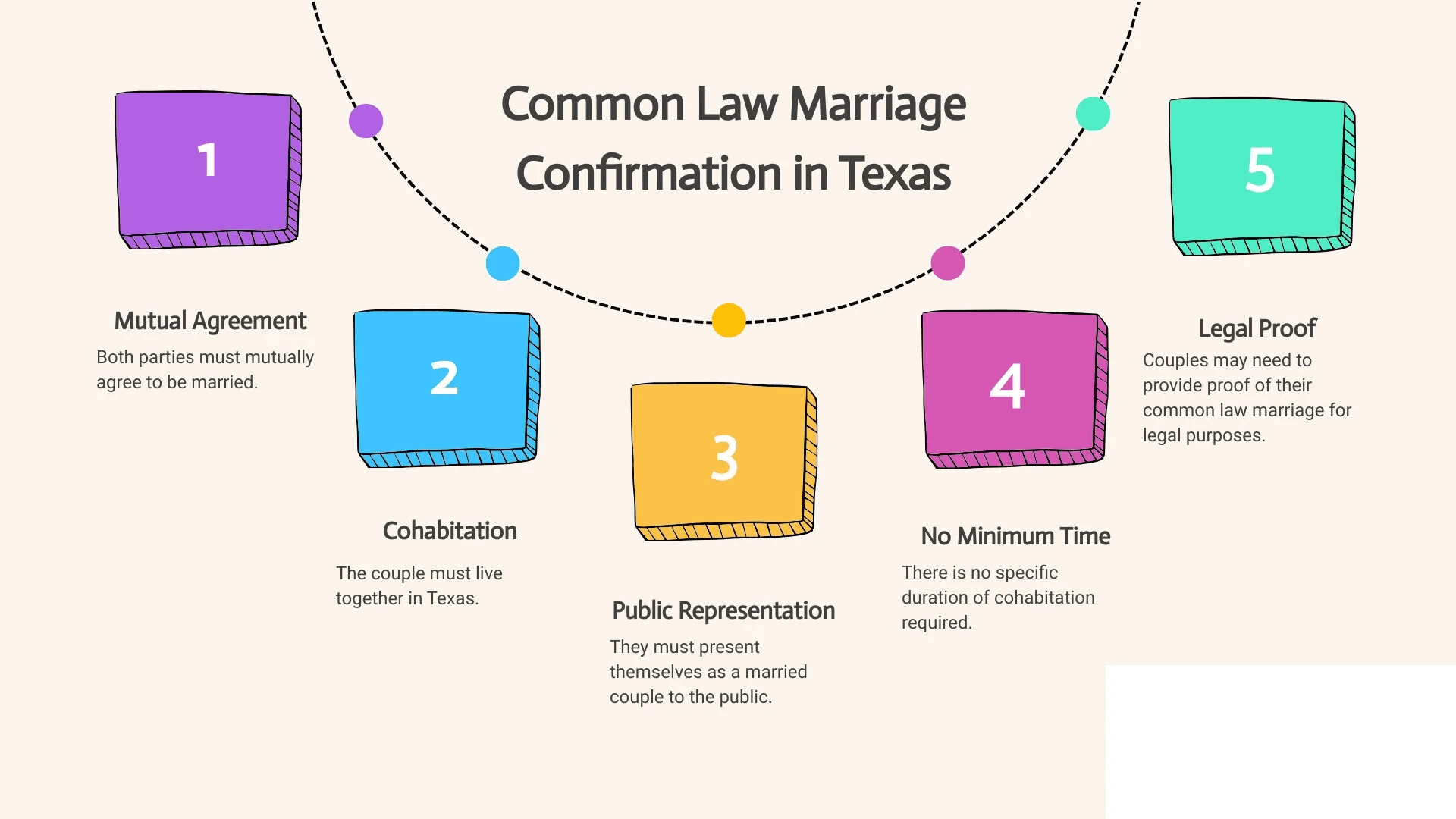
There is no specific duration required to establish a common law marriage in Texas.
Now, let’s dive into what really counts:
- Legal Recognition: Only a few states recognize common law marriages and each has its own requirements.
- State-Specific Laws: Texas, for example, has no minimum time requirement. Instead, couples must meet certain conditions like mutual agreement to be married, living together, and presenting themselves as a married couple to others.
Understanding these factors can help you navigate the complexities of common law marriage, especially in Texas. Here’s a detailed breakdown to set the record straight:
Common law marriage is a type of marriage that doesn’t require a traditional ceremony or a marriage license. Instead, a couple is considered legally married simply by living together and presenting themselves as married to their community.
A common law marriage is essentially a legally recognized marriage between two people who haven’t had a formal wedding ceremony or obtained a marriage license. It’s like being married without the paperwork.
The legal framework for common law marriage varies by state. Only a few states recognize it, and each has specific requirements. Generally, to establish a common law marriage, couples must:
- Live together in a state that recognizes common law marriage.
- Agree to be married.
- Hold themselves out to the public as a married couple, such as by using the same last name or referring to each other as husband and wife.
Unlike traditional marriages, common law marriages don’t involve a ceremony or officiant. There’s no need for a wedding dress, tuxedo, or even a trip to the courthouse. It’s all about the couple’s actions and intentions.
For instance, if a couple in Texas lives together, agrees to be married, and tells others they are married in the state of Texas, they could be considered common law married under Texas law. There’s no need for a priest, judge, or a marriage license.
Consider Angela and Kevin from Texas. They lived together for 23 years and Angela argued they had agreed to be married and presented themselves as husband and wife. Kevin disagreed, leading to a legal battle to determine their marital status. This case shows how complicated proving a common law marriage can be.
Understanding common law marriage helps clear up the myths and provides a clearer picture of what it means to be married without a ceremony or license. Next, we’ll dive into how many years it takes to be in a common law marriage and the common misconceptions around it.
Common law marriage isn’t recognized everywhere in the United States. In fact, only a few states allow couples to form such marriages. Here’s a quick rundown of the states that do:
In Colorado, common law marriage is recognized if the couple agrees to be married, lives together, and presents themselves as a married couple to others. There’s no specific time requirement.
Iowa recognizes common law marriage if the couple intends to be married, lives together continuously, and holds themselves out as married to the public.
Kansas law requires that the couple must be mentally capable of committing, be at least 18 years old, and represent themselves as married in the community.
Montana recognizes common law marriage if the couple agrees to be married, lives together, and presents themselves as a married couple. There’s no specific duration required.
New Hampshire only recognizes common law marriage for inheritance purposes. The couple must have lived together for at least three years before one partner’s death.
Oklahoma is complicated. Common law marriages may be recognized if they were formed before November 1, 1998. However, the laws and court decisions conflict about recognizing marriages formed after that date.
Rhode Island recognizes common law marriage if the couple intends to be married and acts as if they are married. This includes living together and presenting themselves as married to friends and family.
South Carolina recognizes common law marriages that occurred before July 24, 2019. The couple must have agreed to be married, lived together, and presented themselves as married.
In Texas, a couple can establish a common law marriage if they agree to be married, live together, and represent themselves as married to others. There’s no time requirement.
Utah recognizes common law marriage if the couple agrees to be married, lives together, and holds themselves out as married. The couple must file a petition in court to have the marriage recognized.
The District of Columbia recognizes common law marriage if the couple agrees to be married, lives together, and presents themselves as married to the community.
Understanding which states recognize common law marriage and their specific requirements can help clear up confusion. Next, we’ll dive into how many years it takes to be in a common law marriage and the common misconceptions around it.
One of the biggest myths about common law marriage is that you automatically become married if you live together for a certain number of years, usually seven. This is simply not true. No state in the U.S. recognizes a common law marriage based solely on the duration of cohabitation.
Marsha Garrison, a family law professor at Brooklyn Law School, notes: “By far the most common number is seven years. I’ve never figured out where that may have come from and why it’s seven years.” This misconception can lead to confusion and even legal complications if couples believe they are married when they are not.
Common law marriage is recognized in only a few states, and the requirements vary. Let’s look at some examples:
In Texas, common law marriage (also called informal marriage) can be established by meeting three conditions:
- Mutual Agreement: Both parties must agree to be married.
- Cohabitation: The couple must live together.
- Public Representation: They must hold themselves out to others as a married couple here in the state of Texas, such as by using the same last name or filing joint tax returns.
Colorado has a more flexible approach. Couples must cohabitate and present themselves as married to the community. Unlike Texas, there is no need to meet all three conditions simultaneously.
Rhode Island recognizes common law marriage based on the couple’s intent and public representation as a married couple. No specific duration of cohabitation is required, but the couple must prove their intent to be married.
In South Carolina, common law marriage is recognized if the couple lives together and presents themselves as married. Similar to other states, there is no specific time frame required.
Utah requires couples to file a petition in court to have their common law marriage recognized. The couple must also meet conditions like cohabitation and presenting themselves as married.
Understanding these state-specific requirements is crucial. There is no universal “seven years” rule or any other arbitrary time frame that determines common law marriage.
Next, we’ll explore the specific conditions and legal implications of common law marriage in Texas.
In Texas, common law marriage, also known as informal marriage, is legally recognized. However, couples must meet three specific conditions to establish this type of marriage:
- Mutual Agreement: Both partners must agree to be married. This isn’t just about living together; it’s about both parties having a mutual understanding and intention to be married.
- Cohabitation: The couple must live together in Texas. This means sharing a home and daily life, not just occasional visits or short-term stays.
- Public Representation: The couple must hold themselves out to the public as married. This can include introducing each other as husband and wife, using the same last name, or filing joint tax returns.
Meeting these three conditions simultaneously is crucial. If even one condition is not met, the relationship does not qualify as a common law marriage in Texas.
Once a common law marriage is established in Texas, it carries the same legal weight as a ceremonial marriage. This means the couple has the same rights and responsibilities. Here are some key legal implications:
Texas is a community property state. This means that any property acquired during the marriage is considered jointly owned and will be divided equally in the event of a divorce. This rule applies to common law marriages just as it does to ceremonial marriages.
In Texas, spousal support (or alimony) is not guaranteed but can be awarded under certain conditions. For example, one spouse must prove that they cannot meet their minimum reasonable needs and that the marriage lasted at least ten years. For common law marriages, the duration of the marriage is counted from the time all three conditions were met.
If one partner in a common law marriage dies without a will, the surviving spouse has inheritance rights under Texas law. This includes rights to a share of the deceased spouse’s estate, similar to those in a ceremonial marriage.
Understanding these legal implications can help couples make informed decisions about their relationship. For those considering or questioning their common law marriage status, it’s advisable to seek legal guidance to ensure all conditions are met and rights are protected.
Next, we’ll discuss the benefits and drawbacks of common law marriage.
Common law marriage can offer several benefits, but it also comes with drawbacks. Understanding these can help you decide if it’s right for you.
Benefits:
Common law marriage provides legal rights similar to those of a ceremonial marriage. This includes property rights, spousal support, and inheritance rights. For instance, if your partner passes away without a will, you may still inherit a portion of their estate.
Drawbacks:
Proving a common law marriage can be difficult. You need to show evidence of mutual agreement, cohabitation, and public representation. This can lead to legal disputes, especially if one partner denies the marriage existed.
Benefits:
In states that recognize common law marriages, partners may be eligible for spousal health insurance benefits. You can also make medical decisions for your partner in emergencies.
Drawbacks:
Healthcare institutions might not recognize your common law marriage without proper documentation. This can complicate matters during medical emergencies.
Benefits:
In Texas, property acquired during a common law marriage is considered community property. This means it will be divided equally if the relationship ends.
Drawbacks:
Disputes over the date the common law marriage began can complicate property division. Without clear evidence, you might not receive your fair share.
Benefits:
Common law spouses have the same rights and responsibilities regarding child custody as those in ceremonial marriages. Courts will consider the best interests of the child in custody arrangements.
Drawbacks:
Proving a common law marriage can complicate custody battles. If one partner denies the marriage, it could affect the court’s decision on custody.
Benefits:
In Texas, common law spouses may be entitled to spousal support. This is especially important if one partner was financially dependent on the other.
Drawbacks:
To receive spousal support, you must prove the existence of the marriage and meet specific conditions, such as the marriage lasting at least 10 years.
Benefits:
If your common law spouse dies without a will, you have inheritance rights similar to those in a ceremonial marriage. This includes a share of the deceased spouse’s estate.
Drawbacks:
Proving the marriage existed can be challenging, especially if there are no witnesses or documentation. This can lead to legal battles over inheritance.
Understanding the benefits and drawbacks of common law marriage can help you make informed decisions about your relationship. In the next section, we’ll answer some frequently asked questions about common law marriage.
A common misconception is that living together for a certain number of years automatically makes a couple common-law married. This is _not_ true. In states that recognize common law marriage, including Texas, there is no specific duration required. Instead, couples must meet specific conditions, such as mutual agreement to be married, living together, and publicly representing themselves as married.
Living with someone for seven years is often mistakenly believed to result in a common law marriage. This myth is prevalent but incorrect. Simply cohabiting for a set number of years does not make you legally married in any state. Common law marriage requires meeting specific legal criteria, not just living together.
Common law marriage can offer many of the same benefits as a ceremonial marriage. These include:
- Community Property: In states like Texas, assets and debts acquired during the marriage are considered communal and must be divided upon separation or divorce.
- Healthcare Benefits: Common law spouses may be eligible for spousal health insurance benefits.
- Hospital Visitation Rights: You have the right to visit your spouse in the hospital and make emergency medical decisions on their behalf.
- Property Division: Upon separation, property is divided according to community property laws.
- Child Custody: Common law married couples have the same rights and responsibilities regarding child custody and support.
- Spousal Support: You may be eligible for spousal support (alimony) if you meet certain conditions.
- Inheritance Rights: If your common law spouse dies without a will, you have inheritance rights similar to those in a ceremonial marriage.
Understanding these benefits can help you decide whether common law marriage is right for you. For more details, always consult a family law attorney.
One of the most pervasive myths is that living together for a specific number of years, often cited as seven, automatically results in a common law marriage. This is not true in any state, including Texas. The reality is that common law marriage is not about the duration of cohabitation but about meeting specific legal requirements.
Different states have varying rules for recognizing common law marriages. In Texas, for example, the law stipulates three main conditions: mutual agreement to be married, cohabitation, and public representation as a married couple. Each state that recognizes common law marriage has its own set of requirements, making it essential to understand your local laws.
1) How many years does it take to be common-law married in Texas?
Zero—there’s no time requirement. You need agreement, cohabitation in Texas, and holding out as married, all at the same time. _This is general information, not legal advice._
2) What counts as “holding out” as married?
Introducing each other as spouses, consistent use of “husband/wife,” joint paperwork (e.g., benefits), and other conduct showing you present as married—not just private intent. _This is general information, not legal advice._
3) Do we need a ceremony or license?
No. You may optionally file a Declaration of Informal Marriage with the county clerk to formalize the date. _This is general information, not legal advice._
4) If we split up, do we need a divorce?
Yes. An informal marriage is a legal marriage; to divide property and finalize rights, you generally need a divorce decree. _This is general information, not legal advice._
5) Is there a deadline to prove an informal marriage after separation?
If no case is filed within about two years after you stop living together, a presumption arises against the existence of an informal marriage (you can try to rebut it). _This is general information, not legal advice._
6) Does co-owning a house or filing joint taxes make us married?
Not by itself. Those can be evidence of “holding out,” but you still need agreement and Texas cohabitation. _This is general information, not legal advice._
7) How does an informal marriage affect property and support?
Community-property rules apply from the marriage start date, which can impact division of assets/debts and any spousal-maintenance analysis. _This is general information, not legal advice._
Given the complexities and potential legal ramifications, it’s crucial to seek expert advice tailored to your specific situation. Whether you’re considering entering into a common law marriage, or you need to understand your rights and responsibilities within an existing one, consulting a family law attorney can provide clarity and peace of mind.
Understanding the truth about common law marriage can protect your rights and ensure you’re making informed decisions. Don’t let myths and misconceptions guide your actions. Always rely on credible sources and professional legal advice to understand your situation fully.